Switching Mining Hosts Without Missing a Payout
Migrating to a new hosting site is mostly a scheduling problem, not a hardware problem. A 10 PH/s fleet earns about 0.00449 BTC a day at the read-date network hashrate — roughly $379.93 at $84,692 per BTC, or $364.73 after the listed 4% fee on the block-reward component — and the only way to lose part of that in a move is to switch while a settlement window is still open.

Key takeaways
- PPS+ settles hourly against current difficulty, so a switch closed at the top of an hour loses minutes. PPLNS distribution waits for 6 confirmations and is weighted over the last 5 difficulty rounds, so the same switch can leave a full window unsettled.
- Price the gap before you move: at 10 PH/s, one day of missing income is about $379.93 gross, which is a useful upper bound on what a badly timed migration can cost.
- Verify the destination first. Rejected or stale shares of even 1% cost about $3.80 a day at 10 PH/s, and a poor regional link shows up there long before it shows up in a hashrate chart.
- Joining a pool is free; the fee appears on settled payouts as a percentage of the block-reward and transaction-fee components, so it is charged on what you actually receive.
Context in 2026
Hosting changes happen for ordinary reasons: a power contract expiring, a rack lease ending, a site whose cooling is no longer adequate for the machines installed in it, or a capacity expansion that does not fit the existing hall. None of that is unusual, and none of it requires downtime on the hardware itself.
The risk sits entirely in the payout boundary. A mining pool converts submitted shares into money under a published rule, and migration only damages income when the move happens while shares are still inside an unsettled window, or when the destination quietly rejects a slice of the hashrate once the machines arrive.[1]
The two variables that matter
The first variable is the settlement rule. PPS+ pays the block-reward component per share at current difficulty on an hourly cadence, with a listed 4% fee on that component, while the transaction-fee component is distributed under PPLNS logic with a listed 2% fee. PPLNS applies the same 2% listed fee to block rewards and transaction fees together, but only distributes once the block has 6 confirmations and only weights miners over the trailing 5 difficulty rounds.
The second variable is the hashrate ramp at the destination: the interval between a machine being reachable and it being fully productive. Firmware differences, pool endpoint configuration, regional latency and thermal behaviour in a new hall all live in that window.
| Stage | Action | What to verify before moving on |
|---|---|---|
| Days −14 to −7 | Confirm the destination's power availability, cooling capacity and network path | Expected hashrate per machine after thermal ramp, not the label figure |
| Days −7 to −1 | Decide the switch date against the settlement calendar | For PPLNS, that the current weighting window has closed or is about to |
| Hour 0 | Re-point workers to the new endpoint in one pass | Accepted shares within minutes, and stale or rejected rate below the usual baseline |
| Hour 1 | Watch the first settlement under PPS+ | An hourly credit that matches expected shares at current difficulty |
| Day 1 to 7 | Reconcile the first week against pre-move records | Effective hashrate within a percent or two of the fleet's pre-move output |
| Week 2 | Close the migration | No outstanding balance on the previous host and no unattributed shares left |
The ordering matters because the two rules fail differently. Under hourly PPS+, a switch executed at the top of an hour costs minutes of income at most. Under PPLNS, a switch executed mid-window can leave a genuinely earned slice of shares attributed to a weighting window you no longer participate in.
Numbers from a real rig
Put a price on the timing. At 10 PH/s — a realistic fleet for a mid-sized hosted deployment — the read-date arithmetic gives 0.00449 BTC a day, about $379.93 gross. Hourly that is 0.000187 BTC, roughly $15.83, which is the order of magnitude of a failure that lasts an hour.
Now compare the two mistakes. A one-hour endpoint misconfiguration at $15.83 is annoying. Missing a full PPLNS window is measured in days rather than hours, and against a $379.93 daily rate that is the difference between a rounding error and a real number on the monthly statement.
The third number is the one most migrations quietly lose: rejected or stale shares. At the read-date network hashrate, every 1% of effective hashrate lost to poor routing costs about $3.80 a day at this scale, and it is invisible on a nominal hashrate chart. Two percent of stale shares over a month is roughly $228 — considerably more than the fee difference between two payment methods.
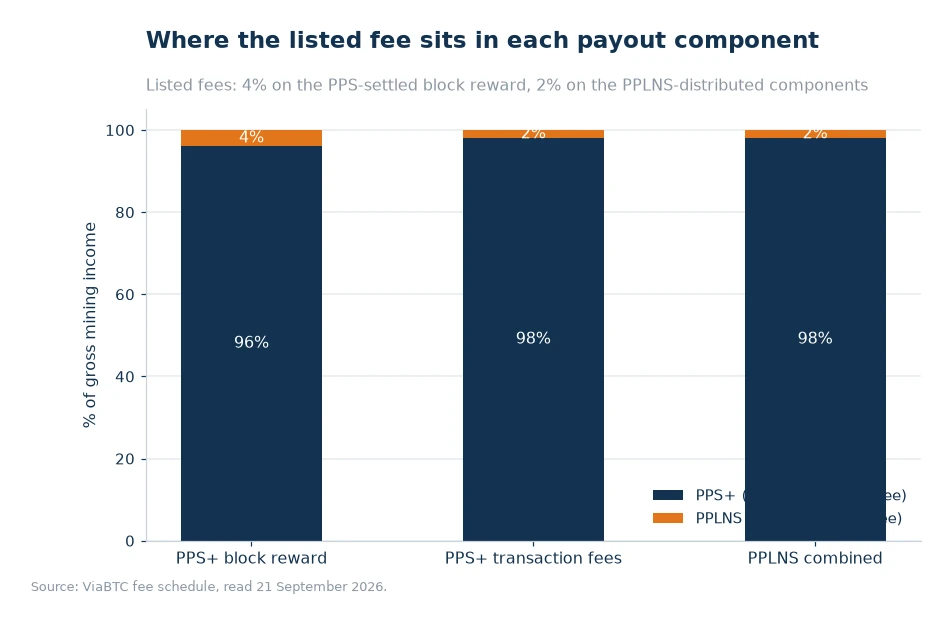
Read the fee chart against the migration calendar rather than in isolation. Because the fee is charged on settled payouts, a move that keeps your hashrate pointed at a paying endpoint never pays a fee on income that was never credited, and never leaves a component unsettled. On a fleet this size the difference between a clean and a sloppy migration is worth more than the fee schedule itself.
Decision guide
- Switch on the settlement boundary, not on the weekend. Under hourly settlement, pick the top of an hour. Under PPLNS, wait for the current weighting window to close.
- Move in one pass if you can. Split migrations leave two partial hashrate footprints and two sets of records to reconcile.
- Verify the destination with a small group first. Point a handful of machines at the new site, confirm accepted shares and stale rate, then move the fleet.
- Keep the old account open until the balance clears. Closing early is how unattributed shares become abandoned shares.
- Match the coin mix to the destination. A site moving machines between chains needs the new endpoint to support them; a multi-coin mining pools setup makes that a configuration change rather than a hardware move.
- Reconcile week one in detail. Effective hashrate, share acceptance and the first settlements, checked against pre-move records while the numbers are still fresh.
The destination itself deserves the same scrutiny as the source. A ViaBTC Mining Farms listing covers hosted capacity with the same account, which means the mining endpoint you point at after the move can be identical to the one before it — no new credentials, no separate settlement calendar, and no gap between the last payout at the old site and the first one at the new one.
Frequently asked questions
Do mining pools cost anything to join?
Joining is free; the pool earns from its fee on settled payouts, which appears as a percentage of the block-reward and transaction-fee components.
Can I mine more than one coin at the same time?
Yes. Merged mining lets a machine secure a parent chain and an auxiliary chain together, and multi-coin pools support switching between chains without moving hardware.
When is the best moment to switch mining hosts?
Switch on the settlement boundary of your payment method: at the top of an hour under hourly PPS+, and after the current weighting window closes under PPLNS.
Does switching hosts change my expected income?
No, as long as effective hashrate and the destination's share acceptance match the source. Expected income tracks your share of network hashrate and current difficulty, not the operator.
The short version
Treat a hosting migration as a settlement project. Fix the switch date against your payment method's window, verify the destination with a subset of machines, and reconcile the first week line by line. The hardware will follow instructions; the arithmetic will not forgive a window opened at the wrong moment. Done in that order, a move between sites costs hours of engineering time and nothing in missed income.
Data and sources: ViaBTC fee schedule and hosted-farm documentation[1] and the ViaBTC pool statistics view[2]. Network hashrate, difficulty, subsidy and BTC price read from public chain data on 21 September 2026. Figures are illustrative and change with difficulty and price.