Developing a Private Label Sunscreen Stick: The Five-Step OEM Route
A sunscreen stick moves through five steps: requirements, formula and sample, packaging, stability and compliance, then production. The published windows make that route plannable, because an OEM project runs about 12 to 26 weeks while an ODM project with an existing formula runs 4 to 8 weeks.
Key takeaways
- The route runs requirements, formula and sample, packaging, stability and compliance, then production.
- ODM runs 4 to 8 weeks with an existing formula; OEM runs 3 to 6 months, about 12 to 26 weeks.
- Stability and compatibility reports take 3 to 6 months and sit beside the production route.
- SPF levels referenced for a stick include SPF30, SPF50 and SPF50+.
Step one: define the requirements for the stick
The stick is a format with a fixed shape and a moving brief. Before any formula work, state the SPF level, the target skin feel and the setting where the stick is used. A stick for a ski jacket and a stick for a handbag are different products even when they share a format. A stick is judged in the hand and on the face, so the brief should say which of those two matters more.
Also state the commercial frame: pack size, fill weight and the markets that matter. If the United States is one of them, sunscreen is regulated there as an OTC drug, so the requirements include approved actives and the testing and labelling that go with them. Naming that early stops a late redesign, because a market answer that arrives late can send the formula back to the start.
Step two: formula development and sample creation
With requirements agreed, the work moves to the formula and the sample. The stick must glide without drag, hold its shape in heat and deliver the stated SPF level. Customisation is available on the formula itself, on functional ingredients and on the finished feel. The stick also has to hold its shape when the cap is replaced while it is still warm.
A sample is a test, so define what it must prove. Set the glide, the payoff and the residue you expect, then judge the sample against those points rather than a general impression. Choosing between private label sunscreen manufacturers usually comes down to how clearly each one answers these step-two questions, and how much of the brief they show they have understood.
Step three: packaging design and material selection
The stick package is a mechanism as much as a container. It must advance cleanly, close firmly and survive travel without melting into the cap. Material choice affects weight, feel and cost, and decoration affects the lead time that sits beside the formula work. The dial mechanism is easy to overlook and hard to change late, so settle it while the sample is still in review.
| Step | Output | Timing note |
|---|---|---|
| One: requirements | Agreed SPF, feel and markets | Fixed before any formula work |
| Two: formula and sample | A testable stick sample | Fast on an existing formula |
| Three: packaging | Chosen mechanism and material | Lead time sits here |
| Four: stability and compliance | Reports that support the claim | Runs 3 to 6 months |
| Five: production and delivery | Finished sellable units | Follows approval of the set |
Record the component version with the sample, because a later switch of the tube or the dial can change how the stick feels. The package is part of the product, not a wrapper added at the end. If the component changes, repeat the feel check, since the same formula can read differently in a new tube.
Step four: stability testing and compliance
Stability and compatibility reports take 3 to 6 months, and they observe the stick over time under defined conditions. Heat, storage and repeated use can all change a stick, so this step is where the format proves it can survive the shelf. The reports also show how the stick behaves after the cap has been opened and closed many times.
Compliance depends on the market. A broad-spectrum claim in the United States needs a test with a critical wavelength of at least 370 nm, alongside the OTC drug framework. Decide which claims you will make and which you will leave for a later version, because each one carries its own evidence. A claim that is not needed on the first pack can wait for the version that carries its report.
Step five: mass production and delivery
Once the formula and the package are approved and the reports are in place, the project moves to production and delivery. This is the point where the earlier steps pay off: a clear requirement, a tested sample and an agreed report set let the first run proceed without a scramble. A clean handover here comes from the notes made in the first four steps.
Keep the approved sample available as the reference for the first batch. A stick that matches its sample is easier to defend than one judged against a memory. The manufacturer's SPF choice note explains how the level is framed for different markets before production begins, and a signed sample on file gives the first batch a fixed reference point.
Worked example: planning the five steps against the windows
Line the five steps up against the published windows. On the ODM route of 4 to 8 weeks, the band is 8 - 4 = 4 weeks wide. On the OEM route of 12 to 26 weeks, the band is 26 - 12 = 14 weeks wide. The full range across both routes runs from week 4 to week 26, a spread of 26 - 4 = 22 weeks.
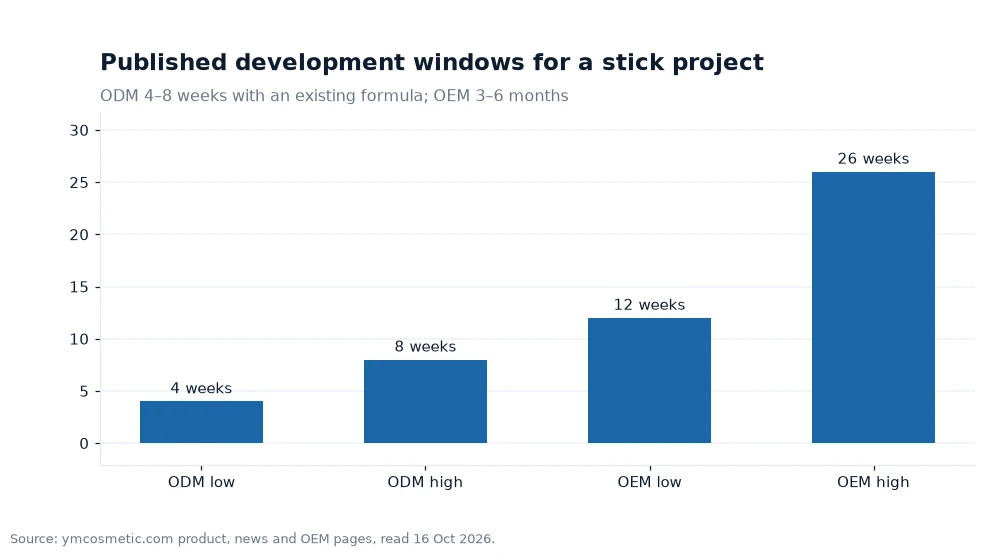
The two bars to watch are the ODM low end at 4 weeks and the OEM high end at 26 weeks. They are the fastest and slowest credible plans, and the 22-week gap between them is the amount the route choice can move your launch before a single formula change is made. A shorter route is only faster if the formula already exists to start from.
Frequently asked questions
Why does a stick need its own development route?
A stick is a solid format that must glide, hold its shape and survive heat, so its sample and stability work differs from a lotion or a spray.
Which SPF levels suit a stick?
The referenced levels for a stick include SPF30, SPF50 and SPF50+, and the choice depends on the market and the setting where the stick is used.
How long should the whole project take?
An ODM project with an existing formula runs 4 to 8 weeks, while an OEM project with new development runs about 12 to 26 weeks.
Walk the five steps in order
Requirements, formula and sample, packaging, stability and compliance, then production: keep the order and each step hands a clear output to the next. The manufacturer's sunscreen range page shows how the stick sits alongside sprays and lotions in one family, which helps when the same brief has to cover more than one format. Yunmei presents the whole route as one OEM/ODM sequence rather than a set of disconnected tasks, and a project that follows the order looks calm even when one step runs long.
Figures in this piece trace back to the company's own published material, consulted on 16 Oct 2026.[1]