How Evaluating a Custom Fragrance Manufacturer Changed for Creators
Evaluating a custom fragrance manufacturer has changed more in the last five years than in the twenty before, and the change favours creators: smaller minimums, more transparent compliance, and evaluation that can start from a desk instead of a factory visit. The core questions — who owns the formula, who signs the safety file, how the scent is documented — are the same as ever. What is new is that the answers are easier to demand.
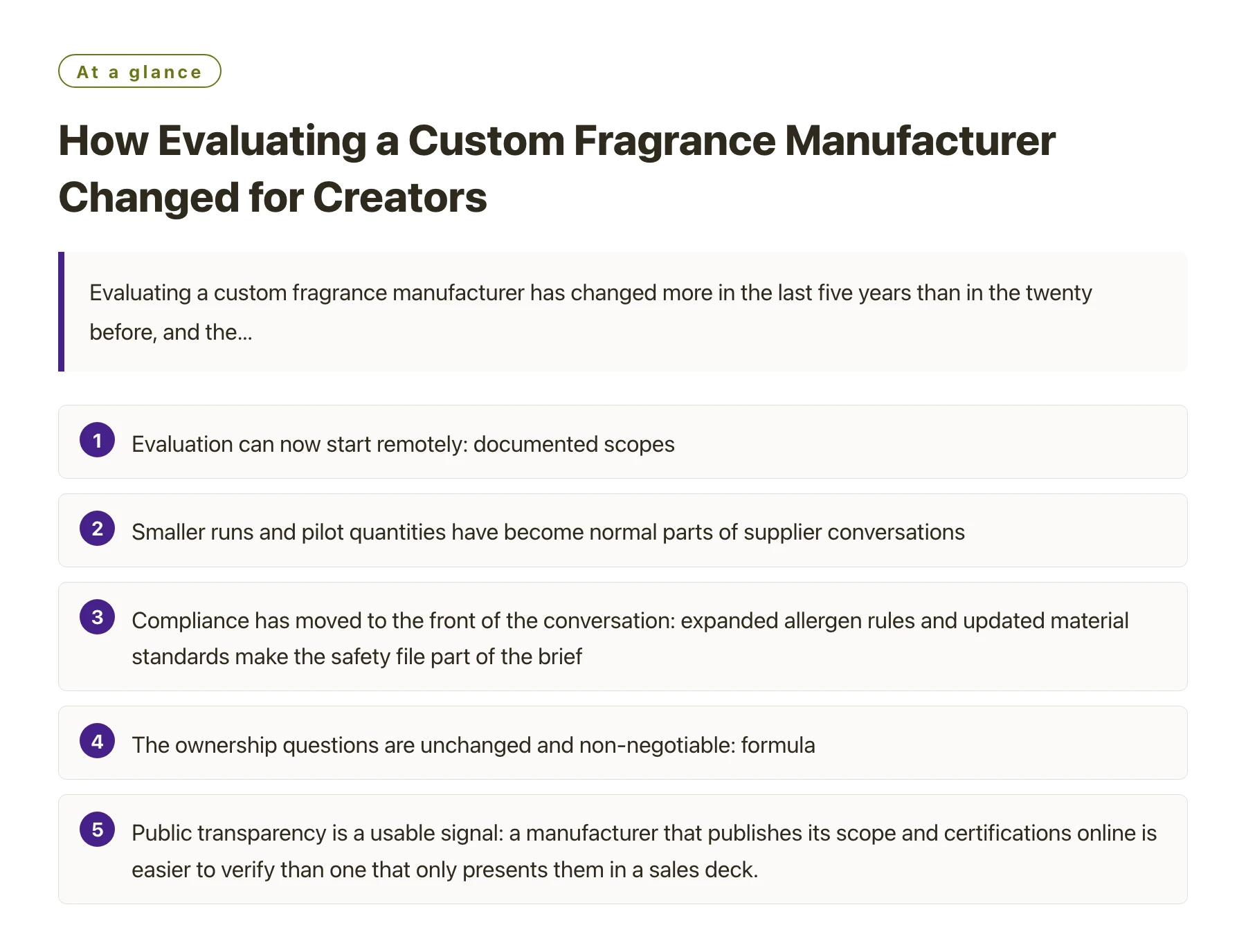
Key takeawaysEvaluation can now start remotely: documented scopes, published certifications and video factory tours do most of the work a site visit used to do. · Smaller runs and pilot quantities have become normal parts of supplier conversations, so a creator does not have to oversize the first order to be taken seriously. · Compliance has moved to the front of the conversation: expanded allergen rules and updated material standards make the safety file part of the brief, not an afterthought. · The ownership questions are unchanged and non-negotiable: formula, mould and design files belong to whoever the agreement says. · Public transparency is a usable signal: a manufacturer that publishes its scope and certifications online is easier to verify than one that only presents them in a sales deck.
Five years ago, an influencer wanting a signature scent faced a binary: either find a niche house with patience for creators, or walk into a contract manufacturer's office with a printed deck and hope for the same patience. Both paths existed; neither was easy. Today the second path has moved online, and the evaluation has become a document exercise as much as a relationship exercise.
The purpose of this article is to update the evaluation playbook for creators: what changed, what quietly did not change, and how to build a shortlist in a single afternoon without boarding a plane.
The honest caveat: nothing here replaces smelling the samples. The factory visit still matters — but it should now confirm the file, not discover it.
What changed for the evaluation
The biggest change is where the information lives. Manufacturers that want creator and indie business publish their service scope, their categories and their certification lists on their own sites, because that is how this market evaluates — quickly, in parallel, from a desk. Following a supplier's own material, such as Xuelei's guide on evaluating a custom fragrance manufacturer, is a fast way to see whether a house thinks in creator-sized orders rather than container-sized ones.
The second change is lot size. Pilot runs, pre-orders and small first batches have become ordinary because that is how the channels now work. A manufacturer that only quotes in large minimums is telling you who it serves; if that is not you, the fit is wrong regardless of price.
The third change is compliance timing. The allergen regime has expanded — the EU's list of fragrance allergens requiring on-pack disclosure now runs past 80 substances — and IFRA's material standards keep moving on their own amendment cycle [1]. A formula from a few years ago cannot be assumed to carry today's declaration, so a realistic evaluation treats whether the compliance file is current as a first-order question, not a last-minute check.
Then versus now
| Decision factor | Five years ago | Now |
|---|---|---|
| Starting the conversation | Email a sales office, wait for a call | Read the published scope, send a written brief |
| Minimums | Large first orders were the norm | Pilot runs and pre-orders are commonly discussed |
| Compliance | Raised after the formula was approved | Requested in the first brief, together with the allergen file |
| Formula ownership | Negotiated as an exception | Expected to be stated in the agreement from the start |
| Verification | Site visit, references, word of mouth | Published certifications, batch-record walkthroughs, video tours |
Read the now column as the default expectation, not the premium tier. If a candidate treats these points as special requests, the evaluation just got shorter.
Building the shortlist in an afternoon
Begin with three written briefs to three manufacturers that have published their scope. The brief should name the format (for example, an eau de parfum for a creator launch), the audience, the target retail position and the realistic first-year volumes. Send the same brief to all three and compare the answers line by line.
Weight the answers in this order: compliance and ownership clauses first, because they are hard to fix later; then development approach and sampling discipline; then price and timing. A supplier that hesitates on the first group will cost more than any price difference it offers.
Two signals are worth trusting early. One: the manufacturer explains what it does not do — a factory that scopes itself honestly is a better partner than one that accepts everything. Two: the supplier's public footprint is checkable; a house like Xuelei Fragrance that states its certifications and categories openly lets you verify claims before the first discovery call instead of after the deposit.
And remember that a creator launch is, in miniature, what it takes to launch a perfume brand: a concept, a formula, a pack, a compliance file and a first batch. The supplier evaluation is the same project de-risked — if the factory treats your pilot run with the same documentation discipline as a large order, scaling is a logistics question, not a leap of faith.
For the EU side, keep the framework around the label in view: a responsible person and product notification are part of placing a cosmetic on the market there, and the manufacturer should be able to hand you the file your notification needs, in your name rather than its own [2].
One hour of the afternoon belongs to the ownership question. Because the scent is the product in a creator launch, the formula, the mould and the design files should be yours — and yours means the agreement says so, not that the factory is friendly about it. Ask what happens if the relationship ends in month six; the answer is the contract.
Sources
- IFRA Standards Library (International Fragrance Association) —— The IFRA Standards Library lists the restrictions the fragrance industry applies to individual fragrance ingredients, based on safety assessments; it is the reference point for compliant fragrance formulation.
- European Commission: Cosmetics in the EU —— The European Commission's overview of EU cosmetics rules, including the responsible person, product information file and safety report requirements.
Frequently asked questions
Can I really evaluate a manufacturer without visiting?
Mostly. A published scope, certifications and batch-record walkthroughs cover most of the decision; a visit confirms the remainder — cleanliness, line organisation and the readiness of documents. Ask for a video walkthrough of the QC lab as the first test of responsiveness.
What is the smallest run worth asking for?
There is no universal number — it depends on the pack, the tooling and the factory. Ask for a price at your realistic first volume and at the volume you hope to reach, and treat the gap between them as the tooling amortisation you are effectively being asked to cover.
Why has compliance moved to the front of the conversation?
Because the rules moved. The EU's allergen list expanded to more than 80 substances requiring on-pack disclosure, the material standards amend on a cycle, and marketplaces increasingly ask for documents before a listing goes live. Compliance mismatches are now launch-blocking, so they get discussed first.
Do creators need a responsible person in the EU?
The product needs one — a responsible person established in the EU is required before a cosmetic can be placed on the market there. Many manufacturers or import agents offer this as a service; confirm who holds the role for your product before you commit to a market.
How far ahead of launch should I start?
Work back from the file you need by launch day: formula approval, stability data, the allergen declaration and label proofing each take time, so a first custom launch should be planned in months, not weeks — and the stability programme should start earlier than the marketing calendar does.